
MII Solutions
How MII Idea Management Helps Organisations Innovate
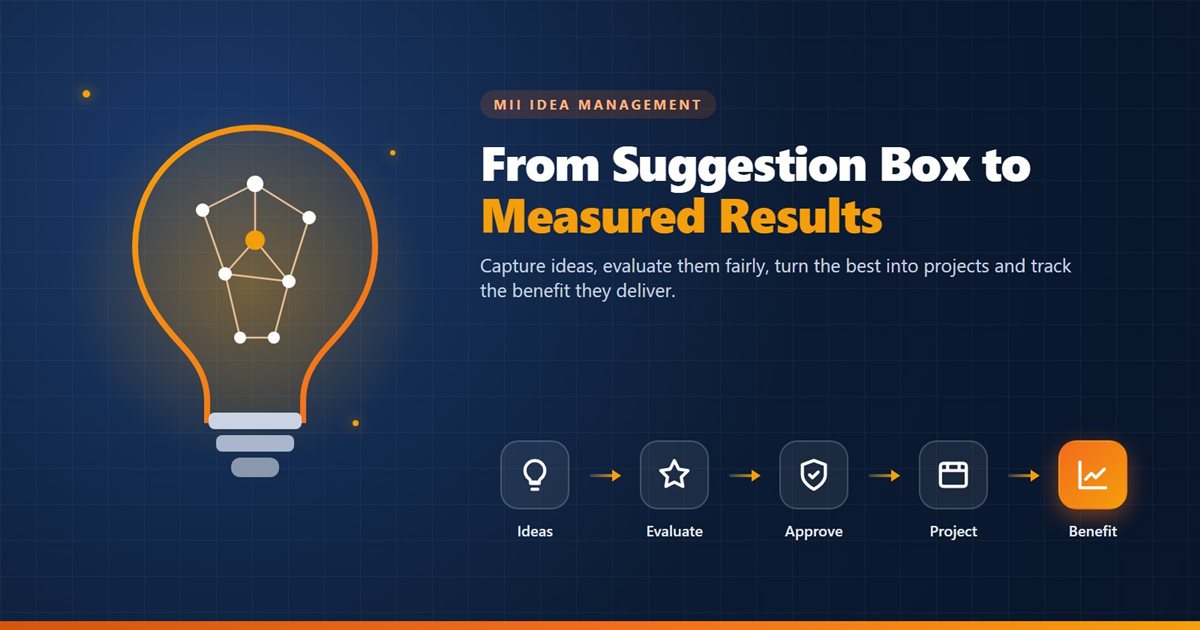
Most organisations are full of good ideas. The difficulty is not finding them, it is capturing them, judging them fairly, turning the best into real projects and proving the benefit. MII Idea Management handles that whole journey in one place.
Every organisation says it values innovation. Employees see waste, customer frustrations and better ways of working every day, and many of them have ideas to fix them. Yet in most organisations those ideas end up in an email that nobody follows up, a suggestion box that is opened once a quarter, or a spreadsheet that only one person understands.
The result is predictable: people stop sharing, management cannot see which ideas were adopted or what they delivered, and the organisation loses a powerful, low-cost source of improvement.
MII Idea Management is an innovation management module from T-XIS that turns ideas into a structured, transparent and measurable process, from the first thought to the benefit it delivers.
Why Idea Programmes Usually Fail
- No focus: ideas arrive on any topic, so reviewers cannot compare them or link them to business priorities.
- No follow-up: submitters never hear what happened, so they stop contributing.
- Unfair or slow evaluation: a single manager decides, often weeks later, without clear criteria.
- Duplicates and weak proposals: the same idea is submitted many times, often with too little detail to judge.
- No path to delivery: approved ideas are not handed over to a project, so they never get implemented.
- No proof of value: nobody can say how much the programme actually saved or earned.
MII Idea Management was designed to solve each of these problems.
1. Focus Ideas with Challenges
Innovation works best when people respond to a clear question. Champions create challenges such as "How can we cut customer response time by half?" or "Ideas to reduce paper in our branches", each with a description, timeline, eligible participants and the business objective it supports.
Each challenge has its own settings:
- A workflow template: a General workflow (screen, evaluate, validate, decide, implement, close) for everyday improvements, or a Concept workflow (submit, concept development, experimentation, deployment, close) with formal approval gates for larger innovations
- Stages that can be renamed, added or reordered to match how your organisation works
- The idea form: the fields submitters must complete, including extra questions specific to the challenge
- Scoring criteria and the rules for moving ideas forward
2. Make It Easy to Contribute, and to Contribute Well
Employees submit ideas from any browser, including on a phone. Before they submit, the module helps them write a better proposal:
- Similar-idea check: it shows existing ideas that look alike, so people can support or build on them instead of creating duplicates
- Quality coach: it points out what is missing, such as the problem, the expected benefit or the cost, before the idea is submitted
- Preview: submitters see exactly how their idea will look to reviewers
- Teams: colleagues can work on an idea together as a team
Organisations can also allow anonymous ideas. No user name, address or points are stored for these. Instead, the submitter receives a private receipt code to follow the idea's progress, so honest ideas can be raised without fear.
3. Evaluate Fairly and Quickly
Good evaluation builds trust in the programme. MII Idea Management makes it structured and fair:
- Routing rules send each idea to the right decision maker and evaluators by department, category, type or any challenge-specific field
- Independent scoring: every evaluator scores alone against the challenge criteria and sees the others' scores only after submitting their own
- Disagreement flag: when evaluators differ widely, the idea is flagged for discussion instead of being decided by an average
- No self-scoring: nobody can score their own idea
- Clear review status: Under review, Pending information, Approved or Declined, with a reason required for every decline
- Questions and answers: reviewers can ask the submitter for more information, and the idea reopens for editing until the answer arrives
4. Move Ideas Forward Automatically, with Control Where It Matters
Ideas should not wait for someone to remember them. Each stage can move ideas on automatically once its conditions are met, such as a minimum score, a number of evaluators, votes or comments, or time in stage. Ideas below a threshold can be parked automatically.
Where control matters, approval gates send the idea through the organisation's MII Approvals hierarchy, and a stage can require a document, such as a concept brief or business case, before the idea moves on. Automation never skips a gate or moves an idea that has an open question.
Stage-time reminders keep reviewers on schedule, and every action is recorded in the idea's history.
5. Test Before You Invest
For bigger ideas, the module keeps a lean test log for each idea: the experiments run, what was learned and the evidence gathered. Decision makers approve investment based on results, not just on a good presentation.
6. Turn Approved Ideas into Real Projects
This is where most idea programmes stop, and where MII Idea Management keeps going. With Send to Project Portfolio, an approved idea becomes a demand in the MII Project and Portfolio Management module, carrying its title, proposal, expected benefit, value, cost and the business objective it supports.
From then on the two modules stay connected:
- If the demand is rejected, the idea is parked automatically
- When the project is closed, the idea is marked as implemented
- The idea shows its demand, its project and the planned versus realised benefit
For the first time, leadership can follow an idea all the way from submission to measured results.
7. Keep People Engaged
Participation grows when contributions are visible and recognised:
- Points and leaderboard for submitting, commenting, voting and having ideas implemented
- Reward catalogue where points can be exchanged for recognition and rewards
- Follow an idea to receive updates on ideas that matter to you
- Kanban board showing every idea by stage, so everyone can see progress
- Resources such as guides and templates to help people develop their ideas
8. Measure the Programme
Champions and administrators get a dashboard and reports that show how the programme is performing:
- Ideas submitted, in review, approved, implemented and parked, by challenge and department
- Time spent in each stage and where ideas get stuck
- Benefit planned and realised from implemented ideas
- KPI targets for the programme, compared with actual results
- Participation and diversity figures across the organisation
Any report can be exported to Excel, Word, PDF or CSV, and a secure, read-only data feed lets the figures flow into the organisation's business intelligence tools.
Who Benefits
- Employees get a simple way to be heard and to see what happens to their ideas
- Managers get fair, structured evaluation and fewer duplicate or incomplete proposals
- Innovation champions run focused challenges and track the whole pipeline in one place
- Leadership sees which ideas became projects and what benefit they delivered
- The organisation builds a culture of continuous improvement, with evidence of its value
It suits banks, financial institutions, public bodies, manufacturers and service companies alike: any organisation that wants to harness the ideas of its people in a disciplined way.
Part of the MII Family
MII Idea Management is built on Oracle Technology products and the Oracle database, and runs in any browser, on premise or in the cloud. It shares sign-in, responsibilities and approvals with the rest of the MII family, including MII ERP+, MII Approvals and MII Project and Portfolio Management, so ideas, approvals and projects live in one connected system.
Frequently Asked Questions
Can employees submit ideas anonymously?
Yes. When a challenge allows it, an idea can be submitted without storing the person's name, address or points. The submitter follows progress with a private receipt code.
Can different challenges follow different processes?
Yes. Each challenge has its own workflow, stages, form, scoring criteria, approval gates and automation rules.
How do approved ideas become projects?
An approved idea can be sent to MII Project and Portfolio Management as a demand. The two stay linked, so project decisions and realised benefits flow back to the idea.
Can we report on the results?
Yes. The dashboard and reports cover the whole pipeline, stage times, benefits and participation, with export to Excel, Word, PDF and CSV and a read-only data feed for business intelligence tools.
See MII Idea Management in Action
Your people already have the ideas. MII Idea Management gives them a place to share those ideas, a fair way to judge them, and a path to turn the best into measurable results.
Book a demo to see a challenge run from first idea to implemented project, or contact T-XIS for a conversation about your innovation programme.